Top 3 Brand In China, Main Editor Of China National Standards
Top Quality PVC/TPO Roofing Membrane Certified by FM Approvals; Representative Brand and Inventor of Chinese Self-adhesive Waterproof Membranes; Presidium Member and Vice President Unit of China National Building Waterproof Association(CWA)

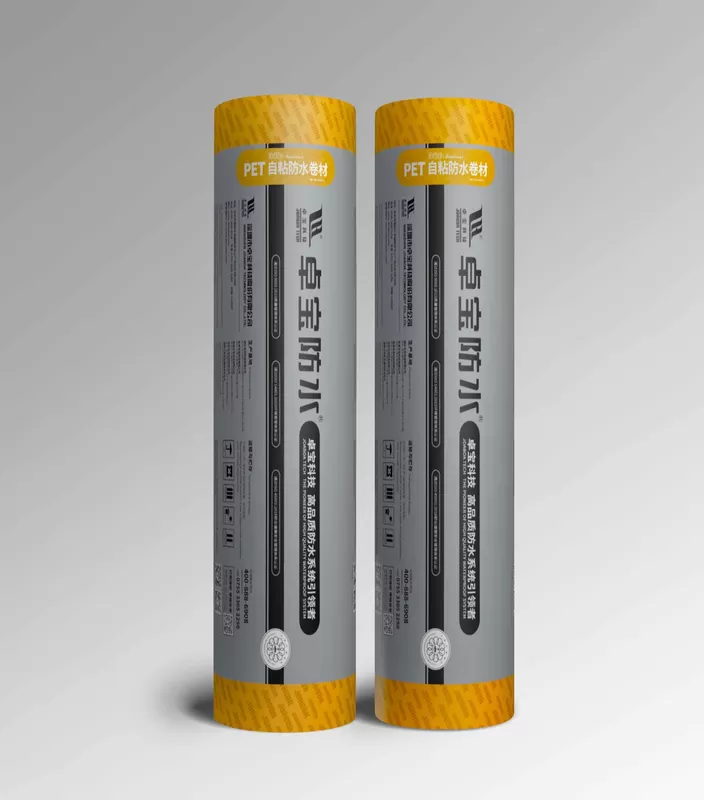
Bondsure® BAC-P CLF-Type Bituminous Waterproofing Membrane Self Adhesive Double Sided
Place of Origin:
CHINA
Brand Name:
JOABOA TECH
Certification:
CE, BBA, SGS, ISO, SIRIM
Model Number:
BAC-P
Minimum Order Quantity:
1,000㎡
Packaging Details:
With or without pallets; For 1.5mm thickness, 11,500 ㎡ can be loaded into 1x20GP if without pallets.
Supply Ability:
10,000,000㎡ per Month
Application Methods:
Wet Application, Hot Application, Dry Application
Tear-resistance:
Waterproof:
Type:
No content displayed at the moment
- Product Details
-
- Commodity name: Bondsure® BAC-P CLF-Type Bituminous Waterproofing Membrane Self Adhesive Double Sided
- Place of Origin: CHINA
- Brand Name: JOABOA TECH
- Certification: CE, BBA, SGS, ISO, SIRIM
- Model Number: BAC-P
- Minimum Order Quantity: 1,000㎡
- Packaging Details: With or without pallets; For 1.5mm thickness, 11,500 ㎡ can be loaded into 1x20GP if without pallets.
- Supply Ability: 10,000,000㎡ per Month
- Application Methods: Wet Application, Hot Application, Dry Application
Place of Origin
CHINA Brand Name JOABOA TECH Certification
CE, BBA, SGS, ISO, SIRIM Model Number BAC-P Application Methods:
Wet Application, Hot Application, Dry Application Minimum Order Quantity 1,000㎡ Packaging Details With or without pallets; For 1.5mm thickness, 11,500 ㎡
can be loaded into 1x20GP if without pallets.
Supply Ability 10,000,000㎡ per Month Highlight: Bituminous Waterproofing Membrane Self Adhesive, Skin Type Bituminous Waterproofing Membrane, Bondsure Self Adhesive Rubber Membrane
Product Description
Bondsure™ Membrane Series
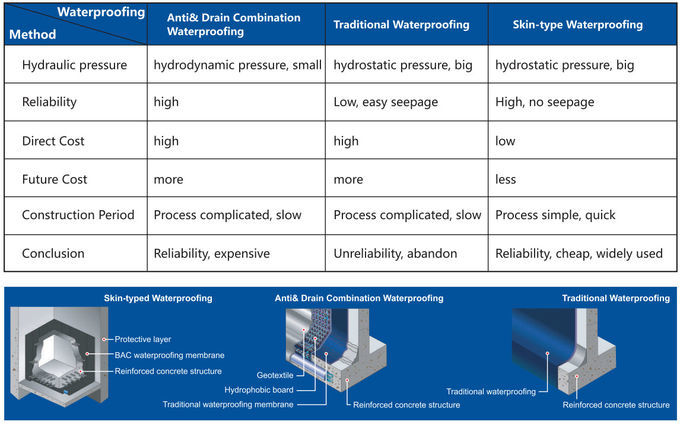
Bondsure® BAC-P CLF-Type Double-sided Self-adhesive Bituminous Waterproofing Membrane is made of HDPE Cross Laminated Film as the intermediate layer, and the two sides are respectively covered with self-adhesive rubber asphalt adhesive material and isolation film. The polymer (chain segment) in the rolling material adhesive and cement hydrate (silicate network) form (interface) interpenetrating network (IPN) structure. The cement can flow and penetrate before the initial setting, then solidification strength increases day by day, the bonding strength is enhanced. The fluidity of cement slurry realizes the micro full adhesion between the membrane and cement slurry, so that the BAC-P bituminous waterproofing material becomes the "skin" of structural concrete, even if the damage point appears, there will be no "water channel" phenomenon.
The cement can flow and penetrate before the initial setting, then solidification strength increases day by day, the bonding strength is enhanced. The fluidity of cement slurry realizes the micro full adhesion between the membrane and cement slurry, so that the BAC-P self adhesive rubber membrane becomes the "skin" of structural concrete, even if the damage point appears, there will be no "water channel" phenomenon.


※ Material Features
1. Cost-Effective
Manufactured by patented production technology, can be bonded with unsolidified cement, to completely eliminate water-channeling.
2. Unique Wet-application Technology
BAC-P CLF-type adhesive roofing underlayment can be applied on wet or uneven substrate surface. No need of primer, not affected by the weather. Especially during rainy season, the advantage is more prominent when compared with hot-applied membrane.
3. Reliable Bonding of Overlapping Edge
As the membrane is self-adhesive type, it's very easy to do the treatment of overlapping areas.
4. Strong Bonding Strength
Membrane adhesive waterproof can be bonded tightly to the substrate, if there is local failure on the membrane, water would be confined in a limited area without fluid-channeling, which makes it much easier to repair.
5. Safe & Environmental-friendly
During construction, there is no solvent or fuel involved. Avoiding pollution, fire risks and saving resources as well.
※ Scope of Application
BAC-P adhesive for waterproof membrane is applicable to waterproof and anti-seepage projects in basement, roof, and other parts of industrial and civil buildings.

※ Construction Methods
BAC-P CLF-type Double-sided Self-adhesive Bituminous Waterproofing Membrane can use construction methods as below: Wet Application, Hot Application, Dry Application.
1. Wet Application
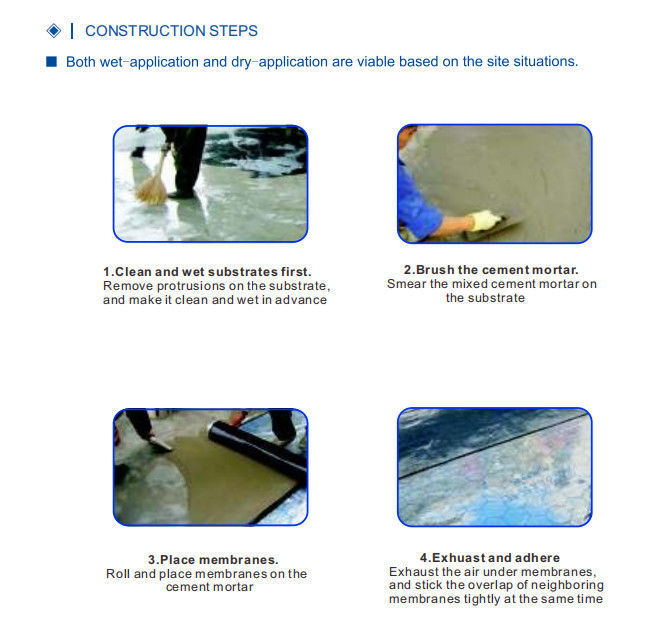
Wet Application is to use cement paste or cement mortar as bonding material to bond the membrane with the base course. This invention is a huge renovation for the waterproof industry. It not only reduces the requirements for the base course during the construction of waterproof membrane, but also greatly improves the bonding effect.
Description of cement mortar used in wet application:
The water-cement ratio is between 0.35 and 0.4, the thickness of the coating on the base is controlled in 3-5mm. Note that the base surface needs to be wet with water first (wet, no visible water), then scratched cement mortar. During the paving of membrane, we should pay attention to exhaust the air, so that the membrane and cement mortar can be completely bonded with each other.
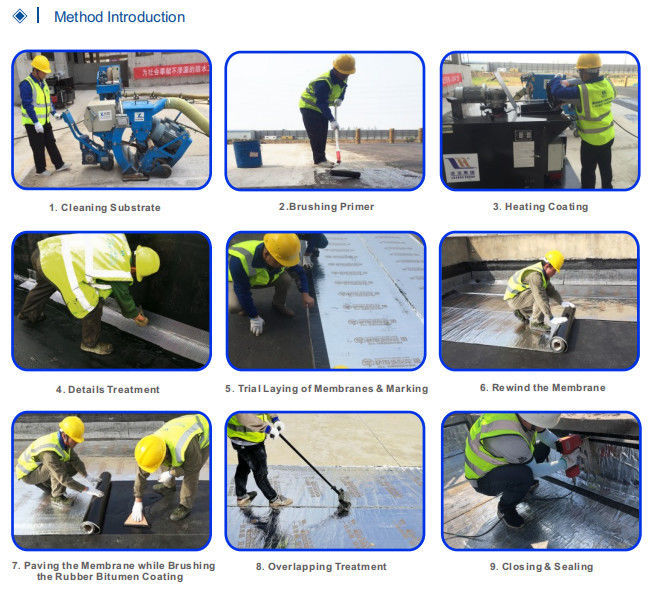
2. Hot Application
HOT APPLICATION is composite of rubber asphalt waterproof coating and self-adhesive membrane which is closely bonded with the base layer to form a "skin-type" waterproof system. It is an organic whole with complementary advantages, which can adapt to the deformation and self-healing performance of the base, effectively prevent water channeling and reduce leakage hazards.
Substrate Requirements
1) The firmness and strength of the base layer should meet the design requirements.
2) The surface of the base layer should be clean and smooth, and there should be no quality defects such as powdering, sanding, peeling, voids and pits.
3) Remove sundries, greasy dirt, sand, etc. on the surface of the base layer, and the cleaning work must be carried out at any time during the construction.
4) If there is clear water on the base layer, it needs to be cleaned before construction. If the base surface is relatively damp, it needs to be dried with a blower.
3. Dry Application
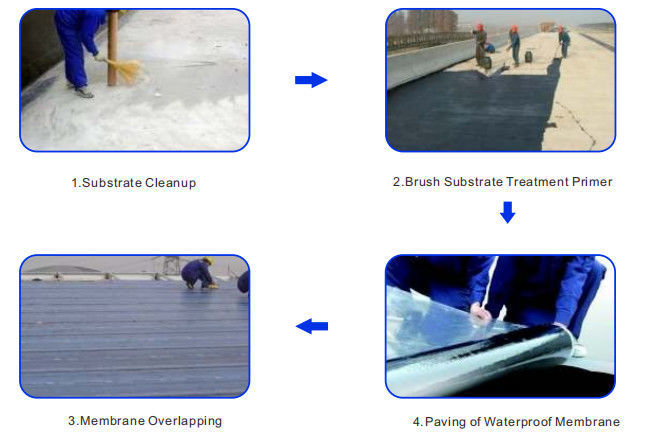
If the substrate condition can meet with designed and standard requirements, flat, even, dry and without dirties, after covering the base surface with primer, the membranes can be paved directly. Al l pipe fitting should be pre-covered as designed and standard requirements, and to be seal treated. The internal and external corners of substrate wipe to circular. The min radius of internal corners is 50mm and the max radius of external is 20mm.
Make sure the moisture content less than 9% (Dry test: pave 1 ㎡ membrane smoothly on the screed-coat, then check the membrane paved side whether has watermark or not after 3~4 hours, if not, it can be constructed).
※ Storage and Transport
1. Different types or specifications of products should be separated, not mixed.
2. Keep self adhesive roofing underlayment dry and ventilated, protected from the sun or rain.
3. Storage temperature should not be higher than 45 ℃. Pile up the membranes flatwise whose stockpile height should not exceed five layers.
4. Prevent tilt or side pressure during transportation, and cover with felt if necessary.
5. Storage time is at least one year from manufacture date if the product is under normal storage condition.
※ Market Share
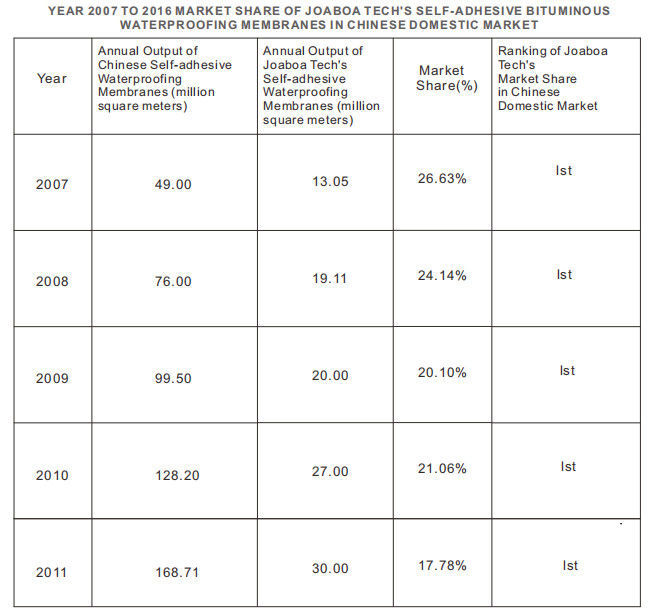
Joaboa Tech, Inventor and Representative Brand of Chinese Self-adhesive Waterproof Membrane, whose market share has ranked as Top 1 in Chinese domestic market for over 10 years, widely used in Viet Nam, Cambodia, India, etc. as well.

Revolutionizing Construction Waterproofing with Advanced Self-Adhesive Bituminous Membrane Technology
In the rapidly evolving construction industry, durability and waterproof integrity are the foundations of long-term building performance. The development of self-adhesive bituminous waterproofing membranes has transformed how engineers and contractors protect concrete structures from moisture infiltration. Among the latest innovations, the BAC-P series of bituminous waterproofing membranes demonstrates how high-performance materials, intelligent chemistry, and versatile application methods can redefine waterproof protection for both industrial and civil engineering projects.
The Science Behind Bituminous Waterproofing
At the core of this advanced waterproofing system lies high-density polyethylene (HDPE) cross-laminated film, which serves as a structural backbone. On both sides of the membrane, a specially formulated rubberized bitumen compound is coated, giving it self-adhesive properties and ensuring consistent bonding strength to a variety of substrates.
This double-sided adhesion forms a continuous and watertight protective layer that functions like the "skin" of reinforced concrete. When the membrane is applied—particularly using the wet bonding technique—the cement slurry penetrates microscopically into the membrane’s surface. As the cement hardens, a chemical interpenetrating network (IPN) forms between the bituminous adhesive and cement hydrate, producing an exceptionally strong and permanent mechanical-chemical bond.
This innovative bonding mechanism ensures that even if minor surface damage occurs, no water channeling effect develops beneath the membrane, maintaining full structural waterproof integrity.
Versatile Application Technologies
The versatility of the BAC-P membrane system lies in its compatibility with multiple installation techniques—wet application, hot application, and dry application—each catering to different site conditions and structural requirements.
Wet Application represents one of the most groundbreaking construction methods in modern waterproofing. It allows the membrane to adhere directly to wet cement mortar or paste without the need for a primer. This not only accelerates construction but also reduces substrate preparation requirements. The resulting seamless adhesion ensures uniform protection, even on uneven or damp surfaces.
Hot Application, on the other hand, combines rubber asphalt coatings with the self-adhesive membrane to form a composite “skin-type” waterproof layer. This hybrid approach enhances elasticity, self-healing capability, and overall system resilience, particularly valuable for dynamic or vibrating structures such as bridges and high-rise basements.
Dry Application remains a preferred choice for conditions that meet high surface standards—smooth, clean, and dry substrates. With the addition of a primer layer, the membrane adheres instantly, offering a reliable and efficient waterproofing solution for large-scale industrial projects.
Superior Material and Environmental Performance
The BAC-P self-adhesive bituminous membrane is designed with sustainability, safety, and practicality in mind. It contains no solvents or volatile organic compounds (VOCs), eliminating toxic emissions during installation. The absence of open flames or fuel-based adhesives also minimizes fire risks, ensuring safe construction on confined or indoor sites.
Moreover, its robust composition makes it highly resistant to chemical erosion, aging, and puncture. The HDPE film provides outstanding tensile strength, while the bituminous layer retains flexibility even under extreme temperatures—from scorching heat to sub-zero conditions.
This combination of mechanical durability and chemical stability allows the membrane to maintain performance across decades of use, even in highly demanding underground or rooftop waterproofing environments.
Applications Across Multiple Construction Scenarios
The BAC-P membrane system is highly versatile and suitable for basements, roofs, tunnels, foundations, water tanks, and industrial floors. In basement waterproofing, its self-adhesive bonding ensures long-lasting protection against groundwater intrusion. On roofs, it offers reliable coverage for both flat and sloped surfaces, reducing the risk of leakage due to weather exposure.
Its ability to adhere tightly to concrete makes it ideal for complex geometries and detail areas such as pipe joints, corners, and expansion joints. Furthermore, its strong compatibility with both cementitious and asphalt-based coatings provides engineers with flexible options for integrating it into hybrid waterproofing systems.
Construction Efficiency and Quality Control
The advanced design of this self-adhesive bituminous membrane dramatically simplifies the construction process. Installation requires no special heating equipment, no primers in wet application, and minimal substrate preparation, significantly reducing labor intensity and project timelines.
To ensure optimal results, cement slurry should be evenly applied with a thickness of 3–5 mm and a water-cement ratio between 0.35 and 0.4. Air must be carefully expelled during installation to avoid air pockets and ensure complete bonding. When applied under correct conditions, the waterproof layer becomes an integral extension of the concrete structure itself, providing unmatched reliability.
Safety, Storage, and Logistics
In terms of storage and transportation, the membranes should be kept dry, ventilated, and protected from direct sunlight. The optimal storage temperature is below 45°C, and rolls should be stacked horizontally without exceeding five layers. These simple yet essential guidelines ensure the membrane retains its full adhesive performance and shelf life, which can reach up to one year under proper conditions.
The product is also engineered for global logistics efficiency—11,500 square meters of 1.5 mm thickness membrane can fit into one 20-foot container without pallets, ensuring economical bulk transport to international markets.
Market Impact and Global Adoption
Over the past decade, self-adhesive bituminous membranes have gained dominance in Asia’s waterproofing sector. The technology’s ability to deliver consistent performance, even under fluctuating weather conditions, has led to wide adoption across Southeast Asia, the Middle East, and Africa.
Today, the BAC-P system is being utilized in commercial complexes, infrastructure tunnels, public buildings, and residential projects worldwide. Its reputation for reliability, cost-efficiency, and simplified installation continues to attract contractors and developers seeking advanced waterproofing solutions that combine performance with sustainability.
Conclusion
The rise of self-adhesive bituminous waterproofing membranes marks a significant milestone in the evolution of construction materials. Through advanced polymer chemistry, HDPE reinforcement, and multi-method installation flexibility, these membranes are redefining how buildings resist moisture and degradation over time.
As infrastructure projects continue to expand globally, the demand for robust, sustainable, and easy-to-install waterproof systems will only grow stronger. The BAC-P series exemplifies how innovation in material science can transform traditional construction practices—creating a safer, greener, and more durable built environment for the future.
Leave a Message
We will call you back soon!



Floor 16th, No.2 North Area, Excellence City Central Square, Meilin, Futian Dist., Shenzhen, Guangdong, China


