Top 3 Brand In China, Main Editor Of China National Standards
Top Quality PVC/TPO Roofing Membrane Certified by FM Approvals; Representative Brand and Inventor of Chinese Self-adhesive Waterproof Membranes; Presidium Member and Vice President Unit of China National Building Waterproof Association(CWA)

Bondsure® S-CLF Self Adhesive Waterproofing Membrane NS ND Type Super Tensile Strength
Place of Origin:
CHINA
Brand Name:
JOABOA TECH
Certification:
CE, BBA, SGS, ISO, SIRIM
Model Number:
S-CLF
Minimum Order Quantity:
1,000㎡
Packaging Details:
With or without pallets; For 1.5mm thickness, 11,500 ㎡ can be loaded into 1x20GP if without pallets.
Supply Ability:
10,000,000㎡ per Month
Application Methods:
Wet Application, Hot Application, Dry Application
Tear-resistance:
Waterproof:
Type:
No content displayed at the moment
- Product Details
-
- Commodity name: Bondsure® S-CLF Self Adhesive Waterproofing Membrane NS ND Type Super Tensile Strength
- Place of Origin: CHINA
- Brand Name: JOABOA TECH
- Certification: CE, BBA, SGS, ISO, SIRIM
- Model Number: S-CLF
- Minimum Order Quantity: 1,000㎡
- Packaging Details: With or without pallets; For 1.5mm thickness, 11,500 ㎡ can be loaded into 1x20GP if without pallets.
- Supply Ability: 10,000,000㎡ per Month
- Application Methods: Wet Application, Hot Application, Dry Application
Place of Origin
CHINA Brand Name JOABOA TECH Certification
CE, BBA, SGS, ISO, SIRIM Model Number S-CLF Application Methods:
Wet Application, Hot Application, Dry Application Minimum Order Quantity 1,000㎡ Packaging Details With or without pallets; For 1.5mm thickness, 11,500 ㎡
can be loaded into 1x20GP if without pallets.
Supply Ability 10,000,000㎡ per Month Highlight: NS Type Self Adhesive Waterproofing Membrane, ND Type Self Adhesive Waterproofing Membrane, Bondsure Self Adhesive Roofing Membrane
Product Description
Bondsure™ Membrane Series
Bondsure® S-CLF Super Cross Laminated Film Self Adhesive Waterproofing Membrane is a kind of bituminous waterproofing products composed of imported super cross-laminated film, self-adhesive rubber asphalt adhesive material with high performance formula, anti-adhesive layer & isolation film, with stronger tensile strength, elongation and tear resistance, and has excellent UV resistance and stability.
Types:
1) Pre-applied Type: YC Type(Pre-laid with sand surface)
2) Self-adhesive Type: NS Type(Single Side Self-adhesive), ND Type(Double Side Self-adhesive)
For this article, we only talk about NS Type and ND Type.
Please refer to S-CLF II Super Tensile Strength Pre-applied Waterproof Membrane (Code: CHINA RED) for more information about YC Type of S-CLF Membrane.


※ Material Features
1. Excellent Physical Properties
It has excellent physical properties and high tensile properties, which is 2~3 times of that of the traditional non-tire self-adhesive coils,
2. High Thermal Stability
Excellent thermal stability, grayish white surface, can effectively reflect light.
3. Excellent Elongation & Dimensional Stability
Composed of super cross laminated film imported from Valeron, with good dimensional stability, can effectively reduce the fold, warping and other conditions; with excellent elongation, can adapt to the deformation of the base.
4. Strong Bonding Strength
The membrane can be bonded tightly to the substrate, if there is local failure on the membrane, water would be confined in a limited area without fluid-channeling, which makes it much easier to repair.
5. Simple Construction Method
Under the same physical performance conditions, the coil is lighter and thinner. Thus, more convenient and faster for the application.
6. Skin-type Waterproofing
For Pre-applied S-CLF Membrane, the upper surface is an anti-sticking layer, which can effectively prevent workers from sticking feet and has a certain puncture resistance effect. In the construction of the basement floor, it can be reverse bonded with the post-cast concrete to achieve the "skin type" waterproof effect, and the bond is firm, even still inseparable with the concrete after long-term immersion.
※ Scope of Application
It is applicable to waterproof and anti-seepage projects in basement, roof, and other parts of industrial and civil buildings.


※ Construction Methods
S-CLF Super Tensile Strength Self Adhesive Waterproof Membrane (NS & ND Type) can use construction methods as below: Wet Application, Hot Application, Dry Application.
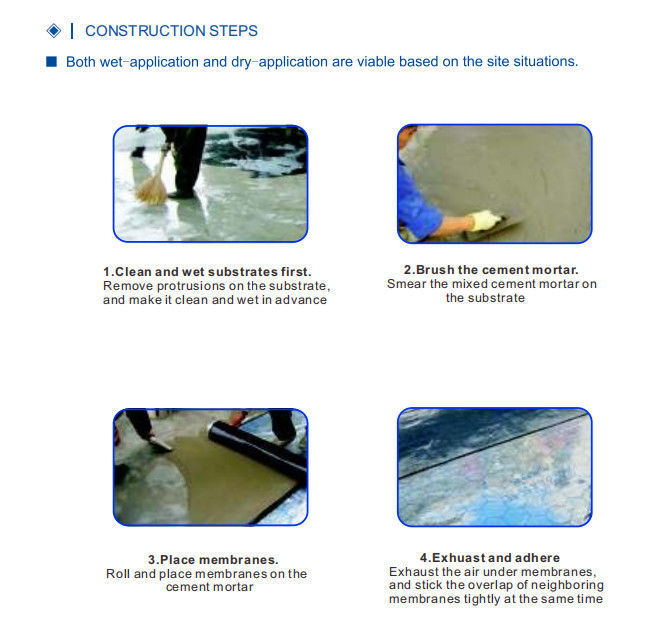
1. Wet Application
Wet Application is to use cement paste or cement mortar as bonding material to bond the membrane with the base course. This invention is a huge renovation for the waterproof industry. It not only reduces the requirements for the base course during the construction of waterproof membrane, but also greatly improves the bonding effect.
Description of cement mortar used in wet application:
The water-cement ratio is between 0.35 and 0.4, the thickness of the coating on the base is controlled in 3-5mm. Note that the base surface needs to be wet with water first (wet, no visible water), then scratched cement mortar. During the paving of membrane, we should pay attention to exhaust the air, so that the membrane and cement mortar can be completely bonded with each other.
2. Hot Application
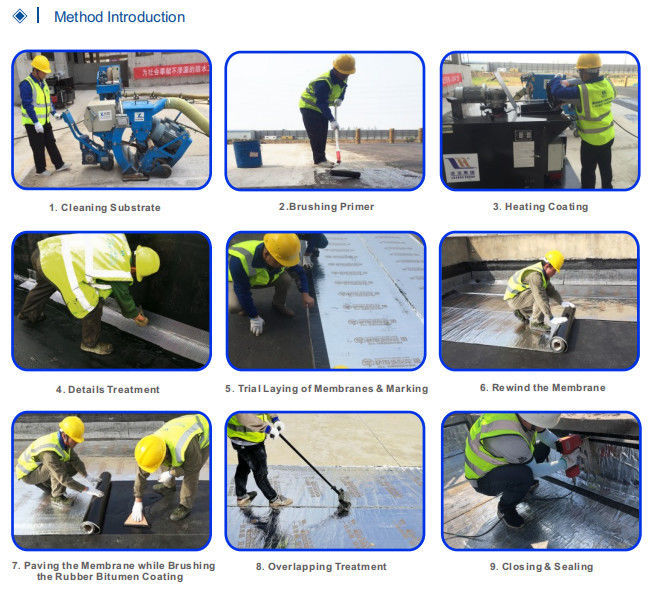
HOT APPLICATION is composite of rubber asphalt waterproof coating and peel and stick roofing underlayment which is closely bonded with the base layer to form a "skin-type" waterproof system. It is an organic whole with complementary advantages, which can adapt to the deformation and self-healing performance of the base, effectively prevent water channeling and reduce leakage hazards.
Substrate Requirements
1) The firmness and strength of the base layer should meet the design requirements.
2) The surface of the base layer should be clean and smooth, and there should be no quality defects such as powdering, sanding, peeling, voids and pits.
3) Remove sundries, greasy dirt, sand, etc. on the surface of the base layer, and the cleaning work must be carried out at any time during the construction.
4) If there is clear water on the base layer, it needs to be cleaned before construction. If the base surface is relatively damp, it needs to be dried with a blower.
3. Dry Application
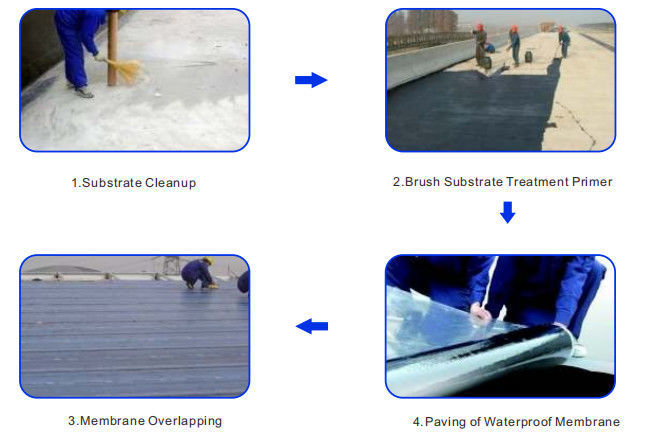
If the substrate condition can meet with designed and standard requirements, flat, even, dry and without dirties, after covering the base surface with primer, the self adhesive rolled roofing can be paved directly. Al l pipe fitting should be pre-covered as designed and standard requirements, and to be seal treated. The internal and external corners of substrate wipe to circular. The min radius of internal corners is 50mm and the max radius of external is 20mm.
Make sure the moisture content less than 9% (Dry test: pave 1㎡asphalt waterproofing smoothly on the screed-coat, then check the membrane paved side whether has watermark or not after 3~4 hours, if not, it can be constructed).
※ Storage and Transport
1. Different types or specifications of products should be separated, not mixed.
2. Keep self adhesive roofing underlayment dry and ventilated, protected from the sun or rain.
3. Storage temperature should not be higher than 45 ℃. Pile up the membranes flatwise whose stockpile height should not exceed five layers.
4. Prevent tilt or side pressure during transportation, and cover with felt if necessary.
5. Storage time is at least one year from manufacture date if the product is under normal storage condition.
※ International & Domestic Certificate
ASTM Testing Report of Bondsure® S-CLF Super Tensile Strength Self Adhesive Waterproofing Membrane (NS Type)

S-CLF has been approved by the Evaluation Committee of Science and Technology Development Promotion Center of Ministry of Housing and Urban-Rural Construction.

※ Market Share
Joaboa Tech, Inventor and Representative Brand of Chinese Self-adhesive Waterproof Membrane, whose market share has ranked as Top 1 in Chinese domestic market for over 10 years, widely used in Viet Nam, Cambodia, India, etc. as well.


1. Product Overview
Self-adhesive waterproofing membranes are advanced flexible sheet systems designed to provide superior waterproofing protection for a variety of structural applications. These membranes feature a pressure-sensitive adhesive backing, allowing them to be applied directly to prepared substrates without the need for heat, welding, or additional mechanical fasteners. The continuous adhesion forms a complete barrier that prevents water infiltration, vapor migration, and moisture damage. They are ideal for use in below-grade foundation walls, tunnels, parking decks, roofs, balconies, terraces, and other areas requiring long-term waterproofing solutions. The membranes are manufactured with precise control over thickness and reinforcement to ensure consistent performance, offering a durable, reliable, and user-friendly alternative to traditional waterproofing methods.
2. Key Features and Benefits
Fully Bonded Adhesion: The adhesive backing ensures the membrane fully bonds to the substrate, eliminating voids that can allow water migration. This full adhesion increases system reliability and enhances performance under hydrostatic conditions.
Ease of Installation: Self-adhesive membranes utilize a peel-and-stick installation process. The protective release liner is removed, and the membrane is pressed onto the substrate. This eliminates the need for torches, hot-applied adhesives, or other specialized equipment, reducing labor costs, safety risks, and installation time.
Consistent Factory Quality: Manufactured in controlled conditions, these membranes maintain precise thickness, uniform adhesive distribution, and dimensional stability. Unlike some liquid-applied systems, the factory-controlled process ensures consistent product performance for each roll.
Durable and Resilient Performance: The membrane is composed of composite materials such as elastomeric bitumen, polymeric films, and reinforced carriers. This composition provides high tensile strength, puncture resistance, and elasticity, enabling it to resist mechanical damage, structural movement, and long-term environmental stress.
Versatile Applications: Self-adhesive membranes are suitable for vertical and horizontal surfaces, both new construction and retrofit projects. They perform effectively in foundation walls, roof decks, terraces, tunnels, parking garages, and other critical waterproofing zones.
Weather and Temperature Resilience: Formulated to withstand a wide range of environmental conditions, these membranes can operate effectively in extreme temperatures, both hot and cold. They maintain flexibility in low temperatures and resist degradation from moisture or temporary UV exposure.
3. Typical Structure and Materials
Self-adhesive waterproofing membranes generally consist of multiple layers that work together to ensure superior protection:
-
Carrier Sheet: Provides dimensional stability, tensile strength, and puncture resistance. Often made of cross-laminated polyethylene or reinforced polymeric film.
-
Waterproofing Compound: Elastomeric materials such as SBS-modified bitumen provide elasticity and robust waterproofing capability.
-
Adhesive Backing: A high-tack, pressure-sensitive layer ensures complete bonding to the substrate.
-
Release Liner: Protects the adhesive layer before application and is removed during installation.
-
Optional Surfacing: Some membranes feature a protective top layer or colored film for temporary UV or physical protection during construction.
4. Application Areas and Use Cases
Below-Grade/Foundation Walls: Applied on vertical concrete or masonry walls to resist hydrostatic pressure and prevent water penetration. Ideal for basement walls, tunnels, and below-grade structures.
Roofs, Roof Decks, and Plaza Decks: Used as waterproofing under insulation, pavers, or tiles. Fully bonded membranes reduce risk of leaks at fasteners or laps and provide a continuous water barrier.
Balconies, Terraces, and Split Slab Construction: Accommodates thermal expansion, minor settlement, and structural movement, making it suitable for exposed deck and balcony applications.
Tunnels, Parking Garages, and Utility Rooms: Offers heavy-duty waterproofing performance, resisting hydrostatic pressure and mechanical damage over time.
Transition Zones and Detail Areas: Excellent for corners, penetrations, and terminations, maintaining a continuous waterproofing barrier where water infiltration is most likely.
5. Installation Guidelines and Best Practices
Substrate Preparation: Ensure the substrate is clean, dry, smooth, and free from dust, oil, or sharp protrusions. Repair any cracks or voids and allow proper curing of concrete.
Primer and Weather Conditions: Some substrates require primer for optimal adhesion, particularly smooth or porous surfaces. Install within recommended temperature ranges to ensure adhesive performance.
Application and Overlaps: Gradually remove the release liner while pressing the membrane onto the substrate. Seams should overlap as recommended, and all overlaps must be firmly pressed. Start vertical installations from the bottom to the top.
Detailing at Corners, Penetrations, Terminations: Apply additional strips or detail membranes at critical points. Protect terminations with bars or sealants as needed. Ensure the membrane remains intact after installation.
Protection and Covering: Protect exposed membranes from UV, foot traffic, and backfill damage. Apply protective boards or drainage sheets if necessary. Membranes should not be exposed to sunlight for extended periods.
6. Technical Performance and Specifications (Text Summary)
Self-adhesive waterproofing membranes are engineered to deliver consistent, reliable, and long-lasting waterproof protection. Their thickness is precisely controlled during manufacturing, ensuring uniform coverage and performance. These membranes are capable of withstanding high hydrostatic pressure, effectively preventing water penetration even under demanding conditions. They offer excellent tensile strength and flexibility, which allows them to accommodate structural movement, shrinkage, and minor settlement without cracking or tearing. Many membranes also provide low-temperature flexibility, ensuring that the material remains effective in cold environments. Their composition is designed for minimal water absorption and vapor transmission, creating a durable barrier that protects structures from moisture damage over time. Overall, self-adhesive waterproofing membranes combine mechanical resilience, environmental adaptability, and stable long-term performance, making them a reliable solution for a wide range of applications, including below-grade walls, roof decks, terraces, and other critical waterproofing areas.
7. Quality Control and Certification
Self-adhesive waterproofing membranes undergo strict quality control throughout production. The manufacturing process ensures consistent thickness, adhesive performance, and dimensional stability. Many products meet international standards and undergo laboratory testing for tensile strength, elongation, puncture resistance, low-temperature flexibility, and hydrostatic pressure resistance. Factory-controlled production ensures each roll delivers predictable performance, providing confidence in both new construction and renovation projects.
8. Competitive Advantages and Selling Points
-
Lower installation labor costs due to peel-and-stick application.
-
Reliable waterproofing performance with fully bonded adhesion.
-
Flexibility to accommodate structural movement and environmental changes.
-
Broad application versatility for both horizontal and vertical surfaces.
-
Export-friendly packaging and supply chain for global markets.
-
Customization support for roll dimensions, branding, and packaging.
9. Packaging, Delivery, and Storage
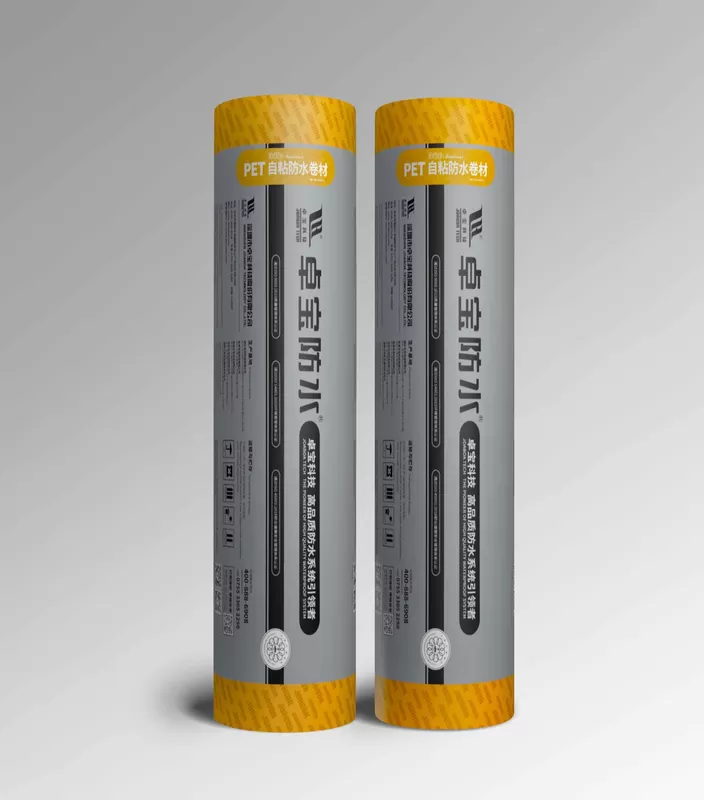
Membranes are typically packaged in rolls, stored upright, and protected from sunlight, moisture, and physical damage. Proper handling during transport and storage preserves adhesive performance and ensures that the membrane is ready for installation when it reaches the site.
10. Frequently Asked Questions (FAQ)
Can self-adhesive membranes be applied to block work without priming? Generally, priming is recommended for porous or rough substrates to ensure optimal adhesion.
What is the minimum installation temperature? Low-temperature variants allow application in cold climates, ensuring adhesive remains effective.
Do membranes require protection from UV exposure? Yes, while some temporary UV exposure is acceptable, long-term protection is necessary to maintain performance.
Can membranes be used as roof underlayments? Yes, they are suitable for roofing under insulation, tiles, or pavers when installed correctly.
Why choose self-adhesive over torch-applied or liquid-applied systems? Self-adhesive membranes provide safer, faster, and more reliable installation, with uniform factory-controlled quality.
11. Brand Positioning for Export Markets
For B2B importers and distributors in global markets, self-adhesive waterproofing membranes offer a compelling value proposition: reduced installation risk, robust long-term performance, flexible logistics, and customizable supply. Highlighting these advantages can strengthen market positioning and support customer confidence in product quality and reliability.
Leave a Message
We will call you back soon!



Floor 16th, No.2 North Area, Excellence City Central Square, Meilin, Futian Dist., Shenzhen, Guangdong, China


